December 2017
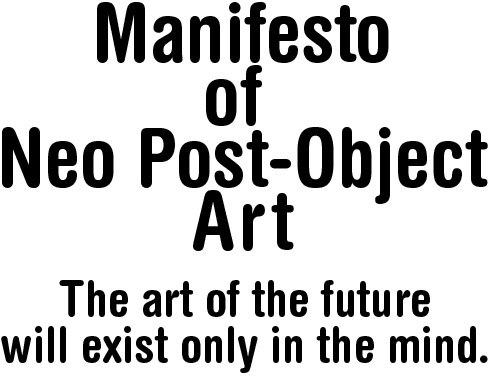
All artworks that have a physical form, no matter how contemporary, are now objects of nostalgia. Likewise artworks wrapped in the aura of technology, stored or displayed on technologically advanced devices, have already become objects of nostalgia.
In order to embrace Neo Post-Object Art, an artist must abandon the physical construction of artworks thereby working entirely intellectually.
The Neo Post-Object artist must adhere to the following principles:
1. The Neo Post-Object artist works entirely intellectually and is not concerned with the physical production of an artwork.
2.The artist produces only the instructions for an artwork.
3. The instructions are not to be used for the making of a physical object or visual representation of the artwork.
4. To avoid being classified as the artwork, the instructions should have no linguistic or graphic ornamentation.
5. The instructions may be of any length but must be communicated in as plain and precise a form as possible.
6. The instructions should exist and be reproduced only in order to convey the artwork.


In the 1960s and 70s the art world shifted its attention to the ideas behind the artwork rather than the finished art object.
This movement was known as Post-Object Art. The shift was aided by new art practices involving photography, video, sound-scape, text, performance, and installation, sometimes creating a total environment. Others employed infrastructure and public utilities including radio, telephone and the postal services. As a result, much of this art was, by its nature, ephemeral.
A example of Post-Object Art is "The Poetry of Chainsaws" by Jim Allen, a New Zealand artist, and a leading exponent of Post-Object Art. (Founding Head, School of Art, Sydney College of the Arts.) This 1976 work featured four petrol-driven chainsaws that are started and left running, vibrating and moving along the floor, while Jim Allen reads aloud "Howl" (1954 - 1955), a Beat Generation poem by Allen Ginsberg. [www.thearts.co.nz The Arts Foundation, Gallery Article]
It should be noted at this point that Post-Object Art and Conceptual Art are now considered by some scholars as arguably interchangeable terms with Conceptual Art being the more universally accepted term. [See: https://teara.gov.nz Article:"Post-object and conceptual art" by Christina Barton]
This type of work shunned the making of objects and challenged the art market. It caused a massive split in the gallery system because suddenly there was a need for non-commercial galleries. These were first established as artist collectives in alternative venues; some of these collectives eventually began to receive government grants and some morphed into government-funded arts bodies and privately funded foundations.
Some artists developed the artefact as the saleable object. Christo's [later: Christo and Jeanne-Claude] work, "Wrapped Coast" is a good example. In 1969, two-and-a-half kilometres of Australia's Sydney coastline were wrapped in plastic. What remains of this ephemeral work are the preparatory drawings and collages and subsequent video and photographic records. These are all now highly valued objects.
The Neo Post-Object Art movement pushes further and removes the object and all of its artefacts from the art market, placing the emphasis more completely on the ideas and concepts behind the artwork.
The Neo Post-Object Art movement recognises that all artworks that have a physical form, no matter how contemporary, have become objects of nostalgia. Likewise artworks wrapped in the aura of technology, stored or displayed on technologically advanced devices, have already or will soon become objects of nostalgia.
A Neo Post-Object artwork may embrace or reflect ideas and subjects that are in themselves nostalgic but the form of the Neo Post-Object artwork is not.
Every individual perceives an artwork differently. We cannot fully predict the reactions and perceptions of the individual to any artwork. Neo Post-Object Art work exists only in the mind meaning that this unknown element is multiplied significantly. That is an exciting proposition for the artist.
Despite Neo Post-Object Art producing no physical art object, record, or artefact, it is anticipated that commercial galleries will devise a way to monetise Neo Post-Object Art given the insidious nature of the art market.
In order to embrace Neo Post Object Art, an artist must abandon the physical construction of artworks thereby working entirely intellectually. This then removes completely the cost of production for Neo Post-Object Artworks.
This movement was known as Post-Object Art. The shift was aided by new art practices involving photography, video, sound-scape, text, performance, and installation, sometimes creating a total environment. Others employed infrastructure and public utilities including radio, telephone and the postal services. As a result, much of this art was, by its nature, ephemeral.
A example of Post-Object Art is "The Poetry of Chainsaws" by Jim Allen, a New Zealand artist, and a leading exponent of Post-Object Art. (Founding Head, School of Art, Sydney College of the Arts.) This 1976 work featured four petrol-driven chainsaws that are started and left running, vibrating and moving along the floor, while Jim Allen reads aloud "Howl" (1954 - 1955), a Beat Generation poem by Allen Ginsberg. [www.thearts.co.nz The Arts Foundation, Gallery Article]
It should be noted at this point that Post-Object Art and Conceptual Art are now considered by some scholars as arguably interchangeable terms with Conceptual Art being the more universally accepted term. [See: https://teara.gov.nz Article:"Post-object and conceptual art" by Christina Barton]
This type of work shunned the making of objects and challenged the art market. It caused a massive split in the gallery system because suddenly there was a need for non-commercial galleries. These were first established as artist collectives in alternative venues; some of these collectives eventually began to receive government grants and some morphed into government-funded arts bodies and privately funded foundations.
Some artists developed the artefact as the saleable object. Christo's [later: Christo and Jeanne-Claude] work, "Wrapped Coast" is a good example. In 1969, two-and-a-half kilometres of Australia's Sydney coastline were wrapped in plastic. What remains of this ephemeral work are the preparatory drawings and collages and subsequent video and photographic records. These are all now highly valued objects.
The Neo Post-Object Art movement pushes further and removes the object and all of its artefacts from the art market, placing the emphasis more completely on the ideas and concepts behind the artwork.
The Neo Post-Object Art movement recognises that all artworks that have a physical form, no matter how contemporary, have become objects of nostalgia. Likewise artworks wrapped in the aura of technology, stored or displayed on technologically advanced devices, have already or will soon become objects of nostalgia.
A Neo Post-Object artwork may embrace or reflect ideas and subjects that are in themselves nostalgic but the form of the Neo Post-Object artwork is not.
Every individual perceives an artwork differently. We cannot fully predict the reactions and perceptions of the individual to any artwork. Neo Post-Object Art work exists only in the mind meaning that this unknown element is multiplied significantly. That is an exciting proposition for the artist.
Despite Neo Post-Object Art producing no physical art object, record, or artefact, it is anticipated that commercial galleries will devise a way to monetise Neo Post-Object Art given the insidious nature of the art market.
In order to embrace Neo Post Object Art, an artist must abandon the physical construction of artworks thereby working entirely intellectually. This then removes completely the cost of production for Neo Post-Object Artworks.
Stephen Richardson
Founder of the Neo Post Object Art Movement.
www.NeoPostObject.com
frontdesk@NeoPostObject.com
Founder of the Neo Post Object Art Movement.
www.NeoPostObject.com
frontdesk@NeoPostObject.com
Stephen Richardson, the author of this document, gives permission for it to be copied and reproduced with the proviso that it is done so in its entirety, including all references, media links and this notice. Further no copyright shall be imposed on this document by any other party.
View the Manifesto as an A4 printable PDF page.
View the Essay as an A4 printable PDF page.